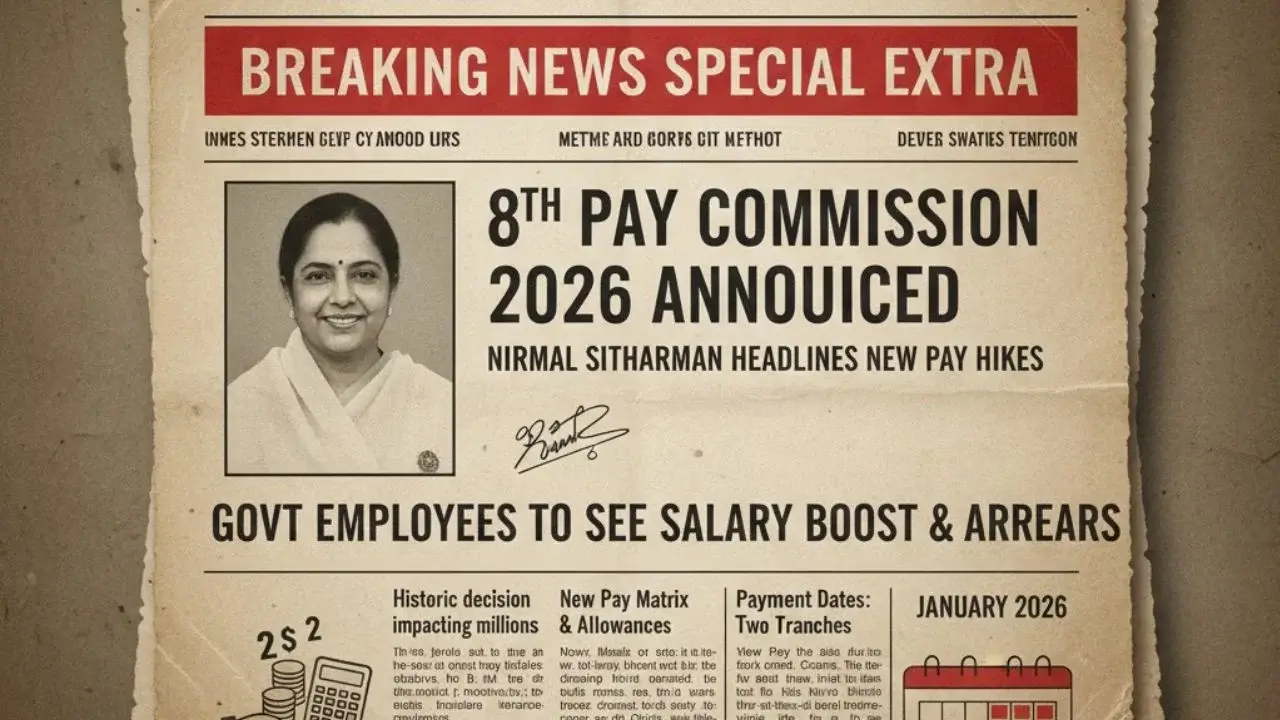
The 8th Pay Commission 2026 is expected to bring significant changes to the salary structure and pension system for central government employees and retirees across India. The Government of India announced the formation of the new commission on January 16, 2025, with implementation likely in early 2026.
More than 50 lakh central government employees and around 65 lakh pensioners are expected to be covered under the new recommendations. The primary objective is to align salaries and pensions with the current cost of living, inflation trends, and evolving economic conditions.
Why the 8th Pay Commission Is Important for Government Employees
A Pay Commission is set up periodically to review and recommend changes in the salary structure, allowances, and pension benefits of central government employees. As inflation increases and household expenses rise, revisions become necessary to maintain financial stability.
The 8th Pay Commission aims to:
Improve the basic pay structure
Rationalize various allowances
Enhance pension benefits
Ensure fairness and transparency in compensation
An updated salary system can help employees manage expenses more effectively, reduce financial stress, and maintain purchasing power. In addition, better pay structures often contribute to improved morale and productivity within government services.
Expected Salary Hike Under 8th Pay Commission
Although the final figures will only be confirmed after the commission submits its report, employees are expecting a noticeable increase in their basic pay.
Key changes may include:
Revision of the fitment factor, which determines salary multiplication
Reset of Dearness Allowance (DA) to zero when the new pay structure is implemented
Fresh DA calculation based on future inflation
Possible revision in House Rent Allowance (HRA)
Updates to travel and medical allowances
The reset of DA to zero is a standard process when a new pay commission is implemented. After reset, DA begins increasing again periodically based on inflation data.
Employees should note that actual increases will depend on the approved fitment factor and government notification.
Pension Reforms: Relief for Retired Employees
The 8th Pay Commission is not limited to serving employees. Pensioners are also likely to benefit from the revised structure.
Possible pension-related reforms include:
Increase in minimum pension amount
Application of a new fitment formula for pension calculation
Reduction in disparity between old and new pensioners
Better financial support to manage healthcare and daily expenses
For many retired employees, pension is the primary source of income. Any upward revision can significantly improve their financial security, especially considering rising medical and living costs.
Economic Impact of the 8th Pay Commission
When lakhs of employees and pensioners receive higher income, it can have a wider economic impact. Increased purchasing power often leads to higher spending in sectors such as:
Retail
Housing
Healthcare
Transportation
Consumer goods
This increase in spending can stimulate economic activity and support business growth. Additionally, improved salary structures can make government jobs more attractive to skilled professionals, strengthening public administration.
However, the overall fiscal impact will depend on the final recommendations and government approval.
Implementation Timeline and Current Status
The commission was announced in January 2025 and is currently in the consultation phase. Discussions are ongoing with various ministries, departments, and employee unions.
The expected timeline is:
Formation: January 2025
Report Submission: Likely by end of 2025
Implementation: Early 2026 (subject to approval)
Final recommendations will be officially released by the concerned authorities after government approval. Employees are advised to rely only on official notifications for confirmed figures.
8th Pay Commission 2026 – Key Highlights
| Category | Details |
|---|---|
| Commission Name | 8th Pay Commission |
| Announcement Date | January 16, 2025 |
| Expected Implementation | Early 2026 |
| Beneficiaries | 50 lakh Central Government Employees |
| Pensioners Covered | 65 lakh Pensioners |
| Main Objective | Salary and Pension Revision |
| Allowances Likely Revised | DA, HRA, Travel, Medical |
| DA Status in 2026 | Reset to Zero and Recalculated |
| Reporting Authorities | Department of Personnel & Training and Ministry of Finance |
Important Points Employees Should Remember
The salary hike is not final until official approval is granted.
The fitment factor will play a major role in determining revised pay.
Dearness Allowance will reset and restart based on inflation data.
Pensioners are included in the reform process.
Financial planning should be based on confirmed government notifications only.
Frequently Asked Questions (FAQs)
Q1. What is the 8th Pay Commission?
It is a government-appointed panel formed to review and revise salaries, allowances, and pensions of central government employees.
Q2. When will the 8th Pay Commission be implemented?
Implementation is expected in early 2026, subject to government approval.
Q3. Who will benefit from the new pay commission?
Approximately 50 lakh central government employees and 65 lakh pensioners may benefit.
Q4. Will pensions increase under the 8th Pay Commission?
Yes, pension revision is part of the commission’s mandate, though final figures will be announced after approval.
Q5. What happens to Dearness Allowance (DA)?
DA will reset to zero once the new pay structure begins and will increase again periodically based on inflation.
Q6. Are salary hike figures officially confirmed?
No, the commission has been formed, but final salary revisions will be confirmed only after the report is submitted and approved.
Disclaimer: This article is for general informational purposes only. Readers are advised to check official government notifications for accurate and updated details regarding the 8th Pay Commission.

Hi, I’m Faiq, the person behind Asdbn. I started this website to share mobile and tech news in a simple and honest way. I regularly follow smartphone launches, updates, and trends, and I like to write about things that are actually useful for readers. My focus is to keep the content clear, genuine, and easy to understand, so anyone interested in mobile and technology news can benefit from it.