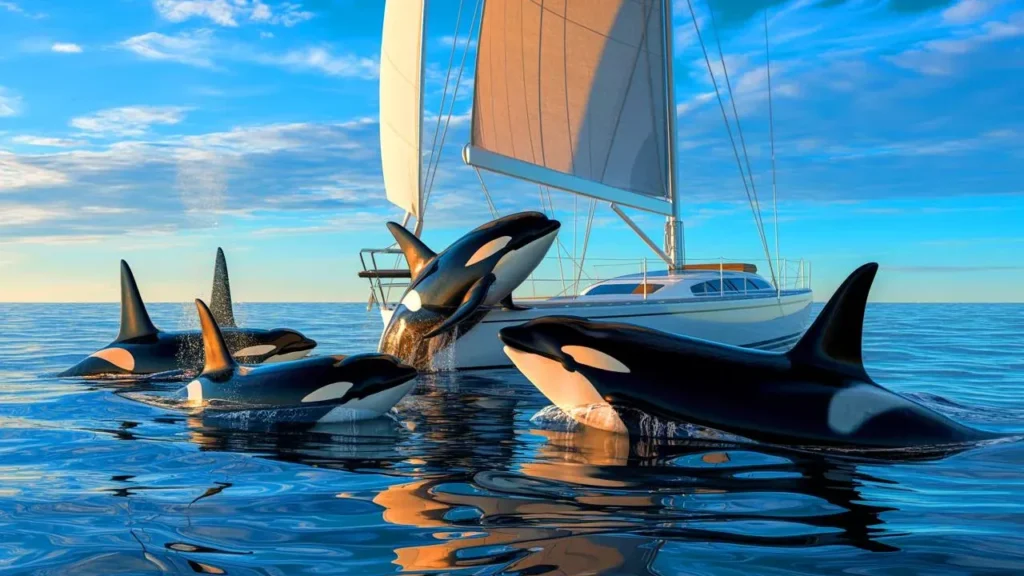
Maritime authorities across the North Atlantic are facing an unexpected and unsettling challenge. Reports are increasing of orcas repeatedly striking commercial and private vessels, with crews describing encounters that feel deliberate, coordinated, and difficult to predict. What was once dismissed as rare or accidental contact is now being treated as a serious navigational risk.
Radio calls between ships follow a similar pattern. A calm voice, precise coordinates, and then a word that immediately sharpens attention on the bridge: orcas. Crews describe shadows beneath the hull, flashes of black and white, and sudden violent shudders as something powerful hits the rudder. For many sailors and commercial captains, these encounters are no longer theoretical.
From Iconic Wildlife to an Operational Risk at Sea
For decades, orcas were celebrated as intelligent and charismatic symbols of the open ocean. Today, that image is colliding with reality. Across waters off Spain, Portugal, and into key North Atlantic approaches, vessels have reported repeated strikes focused almost entirely on steering systems. Rudders are rammed, twisted, and in some cases rendered unusable.
These are not minor bumps. Loss of steering can quickly escalate into a safety emergency, particularly in busy shipping lanes or rough weather. Several vessels have required towing assistance, while others have been temporarily abandoned after taking on water. Although no fatalities have been reported, the financial and operational consequences are growing.
A Pattern That Is Hard to Ignore
What concerns experts and crews alike is the consistency. Orcas appear to target the same vulnerable components again and again. Many incidents describe multiple animals working around the stern, circling tightly and returning to the rudder after each pass. This behavior suggests intention rather than coincidence.
Marine researchers trace the first sustained reports back several years, initially concentrated among a specific population of orcas near the Iberian Peninsula. Over time, similar encounters began appearing farther along common shipping routes. Scientists believe this may be learned behavior spreading within family groups, something orcas are well known for in hunting and play.
Why Are Orcas Doing This?
The question has no single agreed answer. Some researchers believe the behavior may have started as play or curiosity, reinforced when moving rudders responded dramatically. Others suggest it could be linked to negative past encounters with vessels. What experts largely agree on is that orcas are highly intelligent and capable of learning quickly.
Importantly, specialists caution against framing the incidents as “revenge” or aggression in human terms. There is no evidence of intent to harm people. Instead, the focus appears to be mechanical parts of vessels, particularly those that move and create resistance in the water.
How Shipping Crews Are Adapting
Quietly and pragmatically, the maritime industry is adjusting. Captains transiting known interaction zones now plan routes more carefully, sometimes adding distance and fuel costs to avoid recent sightings. Onboard procedures are evolving as well.
Current guidance often recommends reducing speed, disengaging autopilot, and steering manually if orcas appear. The goal is to limit sudden resistance that may encourage repeated strikes. Some operators are reinforcing steering systems during maintenance periods, while others rely heavily on shared reports between crews.
There is also a human element. Encounters can be stressful, particularly for smaller vessels. Many crews now discuss these risks openly before transiting affected areas, recognizing that preparation and calm responses matter.
No Simple Technological Fix
Various non-harmful deterrents have been tested, including sound-based devices, but results so far are mixed. There is no proven solution that reliably prevents interactions without risking harm to marine life. For now, information and situational awareness remain the most effective tools.
Authorities continue to encourage reporting all encounters. This data helps scientists track patterns and refine guidance, even as understanding evolves.
What These Incidents Reveal About Our Oceans
Beyond immediate safety concerns, the situation raises broader questions. Modern shipping has turned parts of the North Atlantic into some of the busiest marine corridors on Earth. Orcas targeting vessels highlight the reality that human activity and complex marine ecosystems are increasingly overlapping.
Many observers note the discomfort this causes. We celebrate animal intelligence until it disrupts our systems. These encounters force a reassessment of how “controlled” the ocean really is, and who adapts when conflicts arise.
Is It Still Safe to Sail?
Despite the attention, most voyages in affected regions still occur without incident. Commercial shipping continues, and recreational sailing has not stopped. However, operators are now treating orca interactions as a legitimate risk factor, similar to weather or traffic density.
For passengers and crews alike, the key takeaway is balance: awareness without panic, respect without mythmaking, and preparation grounded in evidence rather than fear.
Looking Ahead
As reports continue, researchers and mariners are learning in real time. The behavior may fade, evolve, or persist in ways that challenge current assumptions. What is clear is that these encounters are prompting a deeper conversation about how humans share the ocean with intelligent, adaptable wildlife.
In that sense, the orca incidents are more than isolated events. They are reminders that the sea is not just a route for trade, but a living system that responds to pressure in unexpected ways.