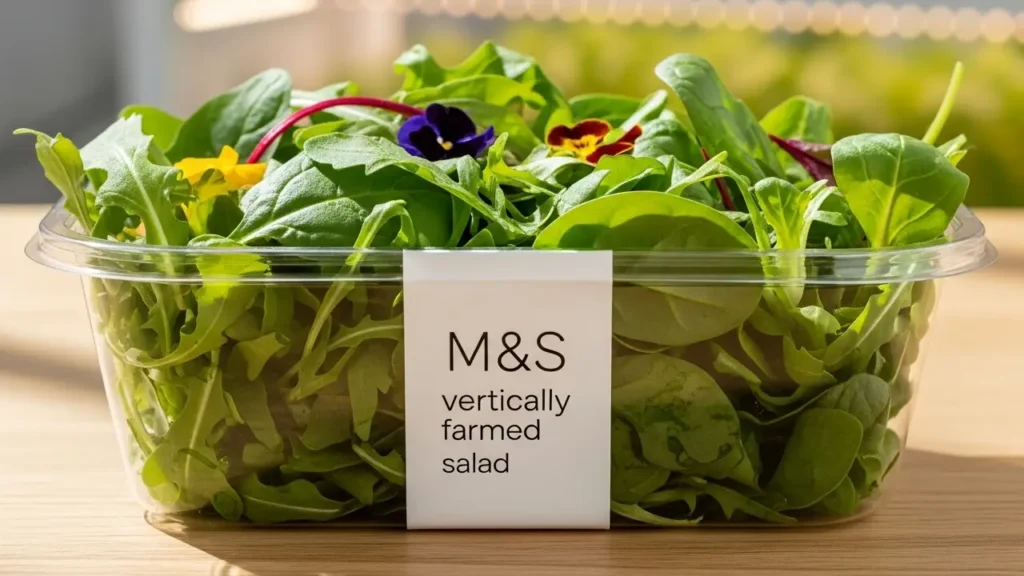
The demand for fresh, sustainable, and locally sourced food is growing rapidly, and M&S vertically farmed salad is a strong example of how innovation is transforming the food industry. As consumers become more conscious about environmental impact and food quality, vertical farming has emerged as a practical solution to meet these expectations without compromising freshness.
Marks & Spencer has introduced vertically farmed salad products as part of its effort to support sustainable agriculture and reduce food miles. These salads are grown in controlled environments, ensuring consistent quality while minimizing the use of natural resources.
What is M&S Vertically Farmed Salad?
M&S vertically farmed salad refers to salad leaves grown using advanced indoor farming systems rather than traditional open-field agriculture. These farms are typically located near urban areas, where crops are grown in stacked layers under controlled lighting and climate conditions.
This method allows for year-round production and ensures that the salads reach stores quickly after harvesting. The result is fresher produce with a longer shelf life and reduced transportation impact.
How Vertical Farming Works
Vertical farming uses innovative technology to grow crops indoors in a controlled environment. Instead of soil, plants are often grown using hydroponic systems where nutrients are delivered directly through water. LED lighting replaces sunlight, allowing crops to grow efficiently regardless of weather conditions.
For M&S vertically farmed salad, this approach ensures that each leaf is grown under optimal conditions. Temperature, humidity, and light are carefully monitored to produce consistent quality while reducing waste.
Key Benefits of M&S Vertically Farmed Salad
One of the main advantages of M&S vertically farmed salad is its environmental sustainability. Vertical farms use significantly less water compared to traditional farming methods and eliminate the need for pesticides.
Another benefit is freshness. Since these farms are located closer to distribution centers, the time between harvesting and reaching consumers is reduced. This helps maintain flavor, texture, and nutritional value.
Additionally, vertical farming reduces dependency on seasonal weather conditions. This ensures a steady supply of fresh salad leaves throughout the year.
Environmental Impact and Sustainability
Sustainability is at the core of M&S vertically farmed salad. Traditional agriculture often requires large amounts of land and water, along with transportation over long distances. Vertical farming addresses these challenges by using compact spaces and efficient resource management.
By reducing food miles, M&S contributes to lower carbon emissions. Controlled environments also mean fewer chemicals are needed, making the salads safer and more environmentally friendly.
Quality and Taste Comparison
Consumers often wonder whether vertically farmed produce matches the taste of traditionally grown vegetables. In many cases, M&S vertically farmed salad offers enhanced flavor and texture due to precise growing conditions.
Because the plants are not exposed to harsh weather or pests, they grow in a stress-free environment. This results in tender leaves and consistent quality that customers can rely on.
Availability and Consumer Demand
The introduction of M&S vertically farmed salad reflects changing consumer preferences. Shoppers are increasingly looking for fresh, sustainable, and ethically produced food options. This shift has encouraged retailers to invest in innovative farming methods.
As awareness grows, vertically farmed products are becoming more widely available. M&S continues to expand its offerings to meet demand while maintaining high standards of quality.
Challenges of Vertical Farming
While vertical farming offers many benefits, it also comes with certain challenges. The initial setup costs can be high due to advanced technology and infrastructure requirements. Energy consumption for lighting and climate control is another factor that needs careful management.
Despite these challenges, ongoing advancements in technology are helping to make vertical farming more efficient and cost-effective over time.
Future of M&S Vertically Farmed Salad
The future of M&S vertically farmed salad looks promising as technology continues to evolve. With increasing investment in sustainable agriculture, vertical farming is expected to play a significant role in the global food system.
M&S is likely to expand its vertically farmed product range, offering more options to consumers who prioritize freshness and sustainability. This approach aligns with long-term environmental goals and changing market trends.
M&S Vertically Farmed Salad
| Feature | Details |
|---|---|
| Farming Method | Vertical Indoor Farming |
| Growing Medium | Hydroponic System |
| Water Usage | Up to 70-90% Less than Traditional Farming |
| Pesticide Use | Minimal or None |
| Harvest Time | Year-Round Production |
| Freshness | Harvested Close to Distribution Centers |
| Environmental Impact | Reduced Carbon Footprint |
| Shelf Life | Longer Due to Controlled Growing Conditions |
FAQs About M&S Vertically Farmed Salad
1. What makes M&S vertically farmed salad different?
It is grown indoors using advanced technology, ensuring consistent quality, freshness, and reduced environmental impact.
2. Is vertically farmed salad healthier?
It can be just as nutritious as traditional produce, with the added benefit of being grown without harmful pesticides.
3. Does vertical farming use less water?
Yes, it uses significantly less water compared to traditional farming methods.
4. Is M&S vertically farmed salad available year-round?
Yes, controlled indoor environments allow for continuous production regardless of season.
5. Is vertically farmed salad more expensive?
It may cost slightly more due to advanced technology, but prices are expected to become more competitive over time.