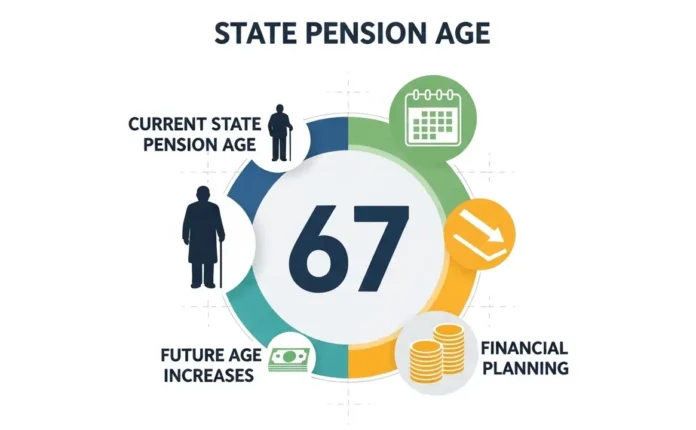
The idea of retiring at 60 has long been associated with traditional workplace pensions in the UK. However, when it comes to the UK State Pension, age 60 has not been the official retirement benchmark for many years. With new government plans confirming the rise in the State Pension age from 66 to 67 starting in April 2026, discussions around working longer have resurfaced.
This change, introduced under the Pensions Act 2014, is part of a phased strategy designed to maintain the long-term sustainability of the pension system. Increasing life expectancy and demographic pressures mean more retirees are relying on support for longer periods. The average life expectancy in the UK now stands at around 81 years, placing added financial strain on public resources.
UK State Pension Age: What Is Changing in 2026?
State Pension 2026 Key Details
Current State Pension Age: 66
New State Pension Age (2026–2028): 67
Full New State Pension (2025–26): £230.25 per week
Expected 2026 Rate (4.8% triple lock increase): Approx. £241 per week
Full Qualifying Years Required: 35 National Insurance years
Future Planned Increase to 68: 2044–2046 (under review)
The State Pension age equalised for men and women at 66 in October 2020. Beginning 6 May 2026, the pension age will gradually move to 67 for those born after 6 April 1960. The transition will be implemented in monthly increments until March 2028.
State Pension Age Timetable by Birth Date
| Birth Date Range | State Pension Age | Effective Period |
|---|---|---|
| Before 6 April 1960 | 66 | Up to May 2026 |
| 6 April 1960 – 5 March 1961 | 67 | 6 May 2026 – 5 March 2028 |
| After 5 March 1961 | 67–68 (future phase) | 2044–2046 (planned) |
Your exact State Pension age depends on your specific birth date. Individuals can check their personal forecast and qualifying National Insurance record through official government services.
Why Retirement at 60 Is Often Misunderstood
Many people associate retirement at 60 with historic final-salary pension schemes that allowed early exits from employment. While women previously accessed the State Pension at 60 before reforms began in 2010, this changed during the equalisation process.
Private pensions operate differently from the State Pension. Individuals can usually access defined contribution pension pots from age 55 (rising to 57 in 2028), regardless of the State Pension age. This flexibility often causes confusion between private retirement options and statutory State Pension eligibility.
2026 Triple Lock Boost: What Pensioners Will Receive
In April 2026, the triple lock mechanism is expected to increase the State Pension by 4.8%, reflecting earnings growth. Under this system, pensions rise by the highest of earnings growth, inflation, or 2.5%.
If the projected 4.8% uplift is applied, the full New State Pension could reach approximately £241 per week, equating to over £12,500 annually. Pension Credit thresholds are also expected to rise in line with the increase, supporting lower-income retirees.
Impact on Workers and the UK Economy
Workers born after 1960 will, on average, need to work an additional year before claiming their State Pension. For some, especially in physically demanding sectors such as construction or manufacturing, this may present challenges.
Employment rates among over-50s have increased significantly in recent years, supported by retraining programmes and flexible work options. From a fiscal perspective, delaying pension eligibility helps manage public finances and fund services such as healthcare and social care.
Private Pension Access Rules in 2026
| Scheme Type | Minimum Access Age | Main Features |
|---|---|---|
| State Pension | 66–67 | Triple lock, inflation-linked increases |
| Defined Benefit | Scheme dependent (55–65) | Guaranteed income, often inflation-linked |
| Defined Contribution | 55 (57 from 2028) | 25% tax-free lump sum, flexible drawdown |
Future Outlook: Will the Pension Age Rise Again?
The government has confirmed a planned increase to State Pension age 68 between 2044 and 2046, although this remains under periodic review. Future adjustments will depend on life expectancy trends and economic conditions.
Policy reviews aim to balance sustainability with fairness, ensuring that the system remains viable for future generations while protecting vulnerable groups.
How to Prepare for Retirement Under the New Rules
Planning ahead is essential. Individuals should:
- Check their State Pension forecast and National Insurance record.
- Consider topping up missing qualifying years where beneficial.
- Review workplace pension contributions and increase them if affordable.
- Explore additional savings vehicles such as ISAs.
- Seek free, regulated financial guidance where needed.
Phased retirement, part-time work, or delaying pension claims may also improve long-term income outcomes. Each individual’s situation is different, and decisions should reflect personal financial circumstances and health considerations.
Final Word: Is Retirement at 60 Really Ending?
Retirement at 60 was never the official State Pension age for most UK workers in recent years. The confirmed rise from 66 to 67 beginning in May 2026 reinforces the government’s long-term pension sustainability strategy.
The shift reflects demographic changes rather than a sudden policy reversal. With clear timelines already in place, workers have time to adjust savings plans and retirement expectations responsibly.

Hi, I’m Faiq, the person behind Asdbn. I started this website to share mobile and tech news in a simple and honest way. I regularly follow smartphone launches, updates, and trends, and I like to write about things that are actually useful for readers. My focus is to keep the content clear, genuine, and easy to understand, so anyone interested in mobile and technology news can benefit from it.