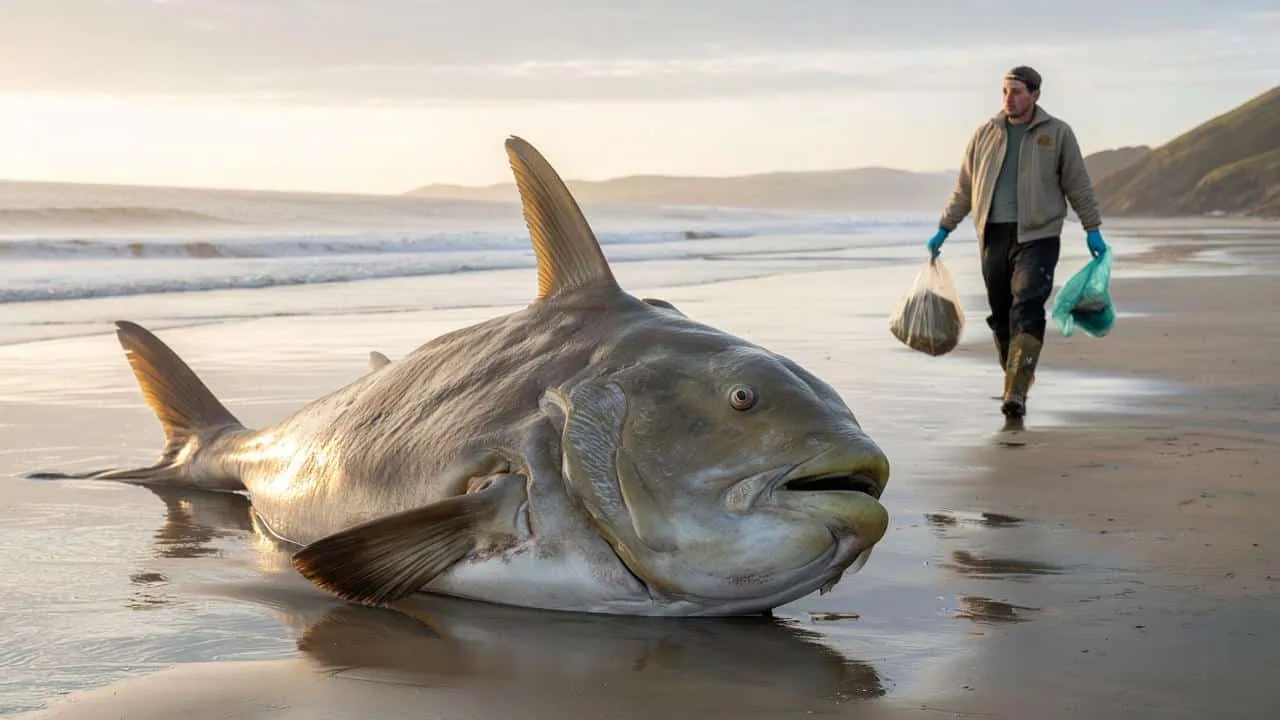
A quiet morning at Bodega Bay turned into a remarkable scientific moment when one of the world’s rarest fish species washed ashore. What initially looked like driftwood or a dead sea lion at Doran Regional Park was soon identified as Mola tecta, commonly known as the deceptive sunfish — a species only formally recognized by science in 2017.
The unexpected discovery has sparked renewed discussion among marine biologists about ocean migration, species distribution, and how changing sea conditions may be influencing marine life.
A Routine Beach Walk Leads to a Rare Discovery
On 7 September, a local professor conducting a routine beach clean-up noticed a large, unusual shape resting on the shoreline. Measuring approximately 1.8 metres (6 feet) long and nearly 90 centimetres wide, the massive fish appeared flat, disk-shaped, and unlike the marine mammals often found stranded along the coast.
Photographs were taken and shared with marine experts, who confirmed the species as Mola tecta. For scientists, this was more than just an unusual stranding — it was a data point that could reshape understanding of the species’ global range.
What Is Mola tecta?
The deceptive sunfish (Mola tecta) belongs to the Molidae family, a group of large, flattened fish commonly known as sunfish. Its name, “tecta,” means “hidden” in Latin — a reference to the fact that it was overlooked for decades and often mistaken for the more familiar common ocean sunfish (Mola mola).
Marine biologist Dr Marianne Nyegaard led the groundbreaking research that distinguished this species from its relatives. Through genetic analysis and detailed anatomical measurements, researchers discovered that what many believed were unusual specimens of Mola mola were actually an entirely separate species.
How the Deceptive Sunfish Differs from the Common Sunfish
At first glance, most sunfish appear nearly identical. However, specialists identify Mola tecta using several subtle features:
- No pronounced snout – Unlike Mola mola, it lacks a protruding nose.
- Smoother, slimmer body – It appears more streamlined and less lumpy.
- No head or chin hump – Adult common sunfish typically have a noticeable bulge that Mola tecta does not.
While these differences may seem minor, they are critical for accurate classification. Correct identification allows scientists to track population patterns, migration routes, and ecological roles more effectively.
A Species Thought to Live in the Southern Hemisphere
Until recently, Mola tecta was believed to inhabit only the southern hemisphere. Confirmed sightings and strandings had been recorded around:
- New Zealand
- Australia
- South Africa
- Southern South America
Researchers also documented its presence in the Humboldt Current, which flows along the Pacific coast of South America. However, this current remains largely within the species’ traditionally understood southern distribution.
The California stranding challenges that assumption. Finding this species on a northern hemisphere beach suggests that its range may be broader than previously believed.
What the California Discovery Could Mean
Large pelagic fish are capable of long-distance migration, but crossing the warm equatorial waters is not always common for species adapted to cooler currents. The presence of Mola tecta in California waters could indicate:
- A wider thermal tolerance than previously documented.
- Changes in ocean temperatures that enable northward movement.
- Shifts in food availability influencing migration routes.
Marine ecosystems are highly sensitive to changes in currents and temperature patterns. Even small shifts can influence where species travel and feed.
Why Do Giant Sunfish Wash Ashore?
Sunfish strandings occur worldwide, but scientists still do not fully understand the exact causes. Possible explanations include:
- Strong currents or storms pushing weakened fish toward shore.
- Injuries from fishing gear or vessel strikes.
- Illness or parasites affecting buoyancy or navigation.
- Rapid temperature changes causing stress.
Post-mortem examinations can sometimes provide answers, including insights into diet, age, and health condition. However, many strandings remain unexplained.
Why This Rare Fish Matters to Science
Although a stranded fish may appear to be an isolated incident, it can significantly influence marine research. Each documented case helps scientists better understand:
- Species distribution and range expansion.
- Migration patterns across hemispheres.
- Long-term ocean climate trends.
Offshore species like sunfish are difficult to monitor. They spend much of their time far from land and often dive deep below the surface. Stranded specimens provide rare opportunities for genetic sampling and biological analysis.
Sunfish: Gentle Giants of the Ocean
Despite their unusual appearance, sunfish are generally harmless. Some individuals can grow beyond 3 metres in length and weigh over 2,000 kilograms. Their diet mainly consists of jellyfish and other soft-bodied organisms.
They are often observed basking sideways near the surface, possibly to regulate body temperature after deep dives or to allow seabirds to remove parasites.
However, these giants face increasing risks from:
- Commercial fishing nets
- Marine plastic pollution
- Ship collisions
Because sunfish reproduce slowly and live long lives, population recovery can take significant time.
What To Do If You Encounter a Stranded Marine Animal
If beachgoers come across a large stranded fish or marine animal, experts recommend the following steps:
- Keep a safe distance, especially if the animal is alive.
- Take clear photographs from multiple angles.
- Record the location, date, and time.
- Contact local wildlife authorities or marine rescue organizations.
Public reports have contributed to scientific mapping of rare sharks, rays, and sunfish species. Accurate documentation can support conservation research and policy decisions.
A Reminder of How Much We Still Don’t Know
The appearance of Mola tecta on a California beach highlights how much remains unknown about the open ocean. Even large marine species can go unnoticed or misidentified for decades.
As ocean conditions continue to shift, researchers expect more unexpected sightings in new regions. For coastal communities, these rare encounters serve as powerful reminders that the sea remains one of Earth’s least understood environments.
The deceptive sunfish may have washed ashore lifeless, but its discovery is providing valuable insight into marine biodiversity, global currents, and the evolving patterns of life beneath the waves.