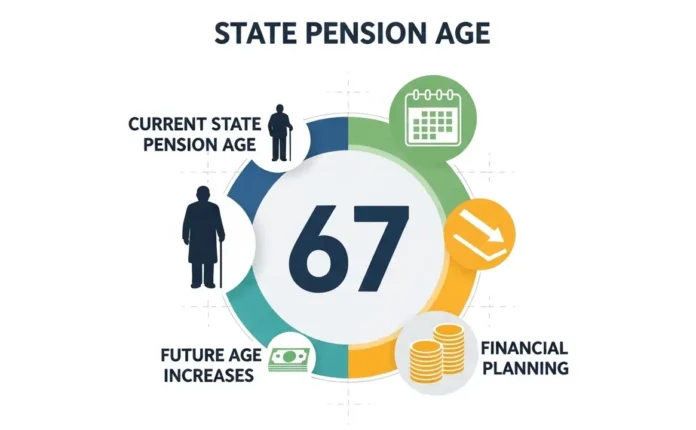
The retirement system in the United Kingdom is undergoing one of its most significant changes in decades. For generations, workers planned their later years around the expectation of retiring in their mid-60s. That assumption is now shifting. From January 2026, new State Pension rules will come into force, gradually increasing the official retirement age and reshaping long-term financial plans for millions of people.
The changes, confirmed by the Department for Work and Pensions, mainly affect people born in the early 1960s. Many in this age group expected to access their State Pension at 66, only to discover they must now wait longer. While the government argues that the move is essential for economic stability, the reality for workers is clear: retirement is being pushed further into the future.
UK State Pension Age Is Officially Rising
From January 2026, the UK will begin transitioning the State Pension age from 66 to 67. This change was legislated years ago under the Pensions Act 2014, but its practical impact is only now becoming real for those approaching retirement.
The rise will not happen overnight. Instead, it will be phased in based on date of birth:
- Born between April 1960 and March 1961 – State Pension age increases gradually beyond 66.
- Born after 5 April 1960 – Retirement age is higher than previous generations.
- Born after 5 March 1961 – State Pension becomes payable at 67.
- Younger workers – Future increases to 68 or beyond remain under review.
This means two people just months apart in age could have different retirement dates, a situation that has caused frustration and confusion among those affected.
Why the Government Is Increasing the Retirement Age
The government’s justification is rooted in demographics and public finances. People are living longer, and the number of workers supporting each pensioner is falling. This imbalance places increasing pressure on the public purse.
Without changes, the cost of funding the State Pension would continue to rise sharply. Officials argue that increasing the retirement age helps ensure the system remains affordable for future generations while avoiding reductions in pension payments.
The Office for Budget Responsibility has repeatedly warned that pension spending is one of the fastest-growing areas of public expenditure. Similar age increases have already been introduced in several other developed countries facing the same challenges.
How the Triple Lock Protects Pension Payments
Despite the higher State Pension age, the government has committed to maintaining the Triple Lock. This policy ensures that State Pension payments rise each year by whichever is highest:
- Average earnings growth
- Inflation, measured by the Consumer Prices Index
- A minimum increase of 2.5%
As a result, people reaching State Pension age in 2026 are expected to receive higher weekly payments than those who retired earlier. Current projections suggest:
- Full New State Pension: around £241 per week
- Full Basic State Pension: approximately £185 per week
These increases are designed to protect purchasing power during periods of rising living costs, though they do not offset the impact of having to work longer.
Concerns for Workers in Physically Demanding Jobs
One of the biggest criticisms of the policy is its effect on people in physically demanding roles. Construction workers, carers, nurses, factory staff, and others often find it difficult to continue working into their late 60s.
While the State Pension age is rising, not all jobs can realistically be performed for longer. Campaigners argue that a one-size-fits-all retirement age does not reflect the realities of health, disability, or long-term physical strain.
Some have called for additional support, flexible retirement options, or enhanced benefits for those unable to continue working due to medical reasons.
Why Checking Your National Insurance Record Matters
As access to the State Pension moves further away, understanding your entitlement becomes increasingly important. To qualify for the full New State Pension, most people need 35 qualifying years of National Insurance contributions.
Gaps in your record can occur for many reasons, including periods of unemployment, caring responsibilities, or time spent living abroad. In many cases, these gaps can be filled by making voluntary contributions.
Reviewing your National Insurance record early gives you time to take action, potentially increasing your retirement income significantly.
Private and Workplace Pensions Are More Important Than Ever
The State Pension is designed to provide a foundation, not a complete retirement income. With the retirement age rising, private savings and workplace pensions play a critical role in financial security.
It is also important to note that the minimum access age for private pensions is increasing. From April 2028, most people will not be able to access private pension savings until age 57.
This creates a potential gap for those hoping to retire earlier than the State Pension age. Careful planning, realistic budgeting, and long-term saving are essential to bridge this period.
What the 2026 Pension Changes Mean for You
The new State Pension rules starting in January 2026 mark a major shift in how retirement works in the UK. For many, the expectation of retiring at 66 is no longer realistic.
While the changes are intended to protect the system’s future, they require individuals to adapt. Staying informed, checking pension forecasts, and reviewing savings plans are now more important than ever.
Retirement may be arriving later, but with careful planning and accurate information, workers can still prepare for a more secure and stable future.

Hi, I’m Faiq, the person behind Asdbn. I started this website to share mobile and tech news in a simple and honest way. I regularly follow smartphone launches, updates, and trends, and I like to write about things that are actually useful for readers. My focus is to keep the content clear, genuine, and easy to understand, so anyone interested in mobile and technology news can benefit from it.