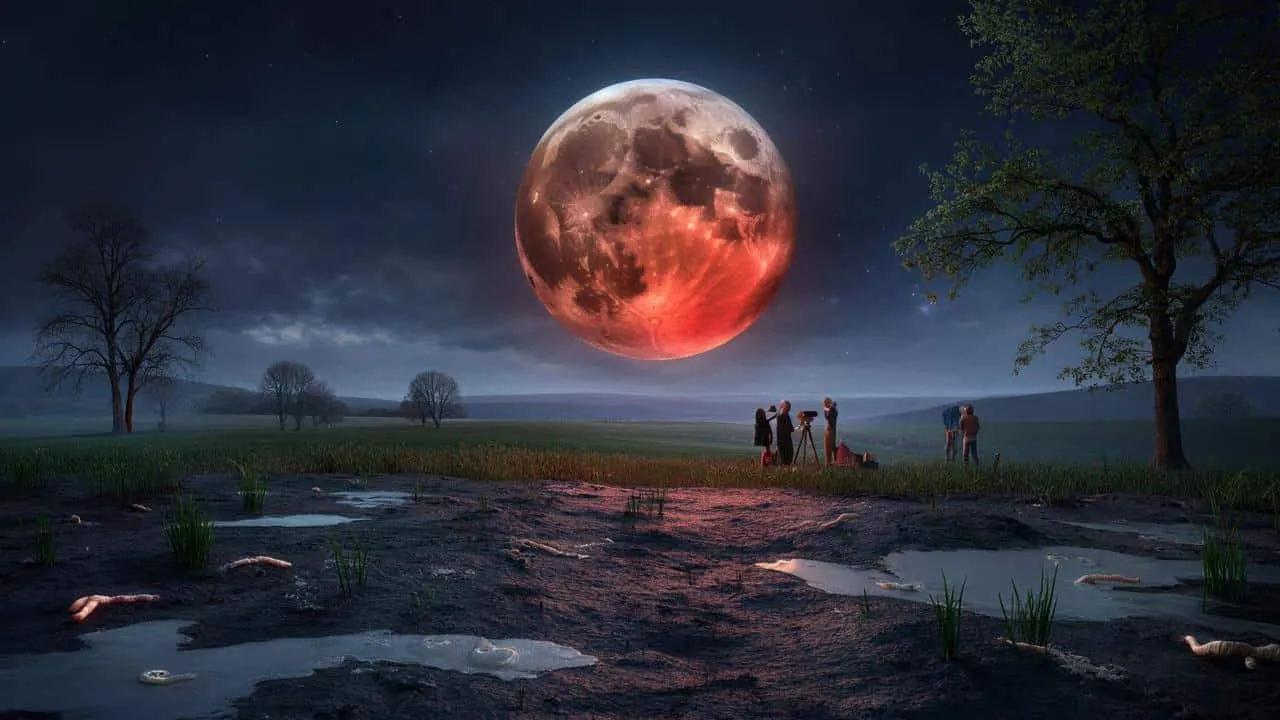
The beginning of meteorological spring 2026 will arrive with an impressive celestial event. On 3 March 2026, the traditional Worm Moon will coincide with a total lunar eclipse, creating a dramatic Blood Moon visible across large parts of the world.
While millions of skywatchers in North America, Asia and the Pacific region will witness the Moon darken and glow deep red, much of western Europe will unfortunately miss the most striking phase of the event due to timing and horizon position.
What Is the Worm Moon and Why Is It Called That?
The March full moon is traditionally known as the Worm Moon. The name originates from Native American seasonal naming traditions. As winter frost began to thaw, the soil softened and earthworms reappeared. Birds returned to feed on them, marking one of the earliest visible signs of seasonal transition.
This connection between the Moon and natural cycles has endured for generations. Today, the term remains widely used to describe the first full moon of March, symbolizing the shift from winter to spring.
In 2026, the Worm Moon reaches its exact full phase at 11:37 UTC (12:37 in Paris) on 3 March. Although the Moon appears full for roughly a day before and after that moment, precise timing becomes important when an eclipse is involved.
Why the March 2026 Full Moon Will Turn Red
A total lunar eclipse occurs when the Sun, Earth and Moon align almost perfectly. The Earth moves between the Sun and the Moon, casting a shadow across the lunar surface.
However, the Moon does not disappear completely. Instead, sunlight passing through Earth’s atmosphere bends and filters toward the Moon. Shorter blue wavelengths scatter, while longer red and orange wavelengths continue through. This filtered light bathes the Moon in a coppery glow, creating what is commonly called a Blood Moon.
For the 3 March 2026 event, totality — the period when the Moon is fully inside Earth’s darkest shadow — will last approximately 58 minutes. The maximum eclipse is expected around 11:33 UTC.
The exact shade of red depends on atmospheric conditions. Dust, pollution, or volcanic particles can deepen the color and dim the brightness of the Moon.
Who Will Be Able to See the Worm Moon Eclipse?
The 2026 eclipse favors observers in the Pacific basin and parts of Asia and North America.
Eastern United States and Canada: Good visibility before dawn. The Moon may set during or shortly after totality.
West Coast of North America: Excellent viewing conditions during pre-dawn hours, weather permitting.
Japan and East Asia: Clear evening or nighttime visibility with the Moon higher in the sky.
Pacific Islands and New Zealand: Very favorable viewing window around mid-eclipse.
Western Europe (including France and the UK): The Moon will be below the horizon during totality, making the event largely unobservable directly.
In cities such as Los Angeles or Tokyo, observers will see the Moon slowly darken and then transform into a glowing red disc. In contrast, viewers in western Europe will need to rely on live streams from observatories.
What Happens If You Are in Western Europe?
For much of France, the UK and neighboring countries, the timing is unfortunate. The Moon sets before totality begins, meaning the most dramatic stage of the eclipse occurs during daylight hours.
Still, enthusiasts can follow live broadcasts from major observatories or space agencies. Planetarium applications also allow users to simulate the eclipse from other parts of the world.
Even without direct visibility, the Worm Moon can serve as an opportunity to reconnect with the night sky. Early March evenings still offer views of prominent constellations and bright stars before spring advances further.
Other Major Sky Events in 2026
The Worm Moon eclipse is only one highlight in an active astronomical year.
Total Solar Eclipse – 12 August 2026: The path of totality crosses Greenland, Iceland and northern Spain. Much of western Europe will experience a partial eclipse.
Blue Moon – 31 May 2026: The second full moon in a single calendar month.
Venus–Jupiter Conjunction – 8–9 June 2026: Two bright planets appear very close together in the sky.
Partial Lunar Eclipse – 28 August 2026: Only part of the Moon enters Earth’s shadow.
Uranus at Opposition – 25 November 2026: The planet reaches its closest and brightest position relative to Earth.
Several meteor showers are also expected under favorable moon phases, including the Perseids in August, the Orionids in October, and the Geminids in December.
How to Watch a Lunar Eclipse Safely
Unlike a solar eclipse, a lunar eclipse is completely safe to observe with the naked eye. No protective glasses are required.
For improved detail, binoculars reveal subtle shades and surface features. A small telescope enhances contrast between the darker central shadow and the brighter outer edge.
Photographers can capture the event using a tripod and manual exposure settings. Even modern smartphones can produce clear images when stabilized and moderately zoomed.
The most important requirements are clear skies, an unobstructed horizon, and patience. Lunar eclipses unfold gradually, rewarding those who watch the entire sequence.
Key Eclipse Terms Explained
Penumbra: The lighter outer region of Earth’s shadow, where dimming is subtle.
Umbra: The darker central shadow where totality occurs.
Totality: The period when the Moon is completely inside the umbra.
Eclipse Magnitude: A measure of how deeply the Moon passes into Earth’s shadow.
A Symbolic Start to Meteorological Spring
The Worm Moon traditionally signals renewal, warmer soil and longer days. In 2026, the addition of a total lunar eclipse gives the March full moon added significance.
Even in regions where the eclipse will not be visible, the date remains a reminder of seasonal transition. For those under clear skies in North America, Asia and the Pacific, the 3 March 2026 Worm Moon Blood Moon promises to be one of the most memorable astronomical events of the year.
As winter loosens its grip and spring begins to take hold, the alignment of Sun, Earth and Moon offers a striking example of cosmic precision — and a powerful visual marker of change.